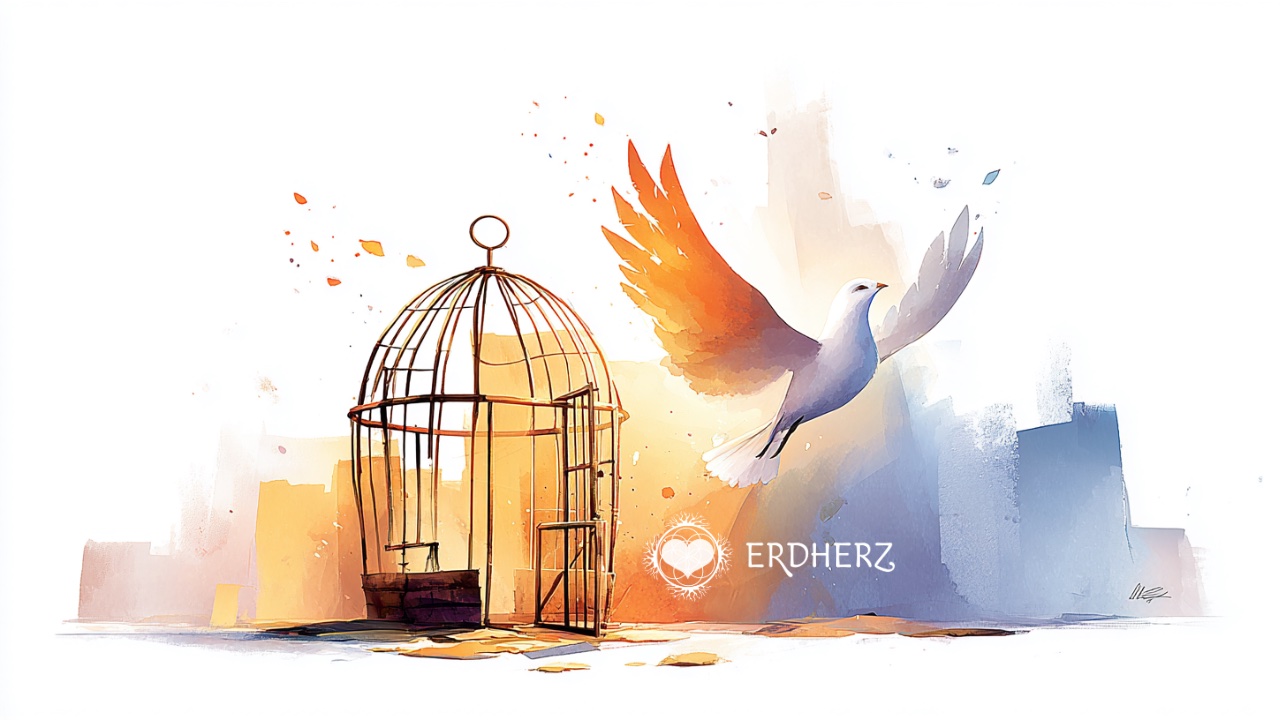
What you love, let go.
If it comes back to you, it is yours forever.
— Confucius
These words once opened a doorway in the way I approach relationships. Today I know that they point far beyond relationships. They touch a universal principle of inner freedom.
When we think of non-attachment, many of us picture deprivation and renunciation. And then the thought quickly follows: Yes, that would be good—but I cannot do that.
In my experience, the exact opposite is true.
Non-attachment is not a loss.
It is a key.
To freedom. And to abundance.
What remains when we let go of everything?
What remains when we dissolve every attachment—along with the stories and identifications we believe in? When we let go of everything we think, feel, and believe ourselves to be—and simply are?
Each of us must explore that for ourselves.
Because if I write here that resting in our true being can, among other things, be experienced as a state of complete abundance, you read it. Perhaps you nod. Perhaps you can believe it. Perhaps not.
Either way, it remains a cognitive understanding.
But for a moment, let us suppose you can experience it for yourself. What does the universe do when we have found complete abundance within? How do the cosmic laws I have written so much about here come into play?
As within, so without. The principle of resonance. Cause and effect.
The outer world begins to reflect what we have come into resonance with inwardly.
A personal example:
We searched for a house for our family for a long time. Promising places came along, but something always fell through. Only when I had reached a place within myself where I knew, My home is within me, did the right house come to us.
Acting without attachment
Non-attachment does not mean withdrawing from life. Quite the opposite. In yoga, there is a central principle that begins at exactly this point: the yoga of action—Karma Yoga.
In the Bhagavad Gita (2.48), Krishna (an incarnation of God) speaks to Arjuna—just before he goes into battle—to this effect:
Do what needs to be done.
Give it your best.
But do not cling to the fruits of your actions.
This is often understood as a call to fulfill one’s duty. But that is too narrow a reading. This is not about external expectations, roles, or what others want from us.
What is meant is Dharma—the inner task we have chosen for this life at the level of the soul. Something that is not always pleasant, but feels true.
For Arjuna, that means fighting.
Not out of a desire for battle.
Not out of ego.
But because fleeing in this moment would be untruthful.
Non-attachment reveals itself here not in inaction, but in action without inner attachment. And that is the key.
Without a claim.
Without expectation.
Without identifying with the outcome.
When we do not cling to the fruits of our actions, there is no inner doubt about whether they might be “good enough.” No pressure to have to achieve something. These are two simple examples of how inner tension arises—and it is precisely this tension that has an effect outwardly.
In this way, action becomes free. And, paradoxically, often more effective than ever before.

The one constant in your life
Perhaps you remember yourself as a young person.
Your body was different.
Your thoughts were different.
Your feelings were different.
And much of what you believed then is no longer the same today.
And yet:
When you looked in the mirror then—and when you do so today—
the being that looks is the same.
Not the “I” of the personality you identify with. But the pure feeling of your existence. The Who is here? Who feels. Who thinks. Who perceives. The one constant throughout your life. That which has never changed—and never will.
“I am not my socks”
A tutor once said that during my yoga teacher training. And because it is so funny, it stayed with me. At the same time, it is so true.
In Vedanta Yoga, there is a simple and very powerful insight:
Imagine, for example, a forward bend such as the Plough pose. As you lie there, you look past your thighs at your socks. I can perceive my socks. So I cannot be my socks.
Many people say, of course—and that is precisely why it is funny.
We can close our eyes and consciously notice that we are still here. So we are not what we see. Nor are we the sounds we hear.
But what about our thoughts?
Our feelings?
The stories we believe in?
Our personality—the thing we believe defines us?
Again, each of us can only explore this for ourselves.
Can you observe it?
What non-attachment means
With anything you can perceive, you can recognize that you are perceiving it—
and let it move on at the same time. Do not cling to it. And that is precisely what non-attachment means.
You can have a very simple yet profound experience of this if you take a few minutes—perhaps five to ten.
Sit down. Closing your eyes works well, but you do not have to. Then a thought appears. That is completely normal and not a problem at all. You do not need to try not to think.
You simply do not need to cling to that thought and spin it further. Because our mind is clever: one thought follows another, feelings attach themselves—and suddenly you are right in the middle of it again.
So:
Simply notice that you are thinking right now.
Know: you are not this thought.
And—however interesting or important it may seem—
just let it move on.
And with time
It grows ever
Quieter
And quieter…
Closing
At this quiet point, I will leave you to yourself now. And—if you wish—to this simple practice.
May my words help you exactly where you are. I am glad that you are here.
In connection,
Benjamin