Some figures appear again and again.
Under different names.
In different cultures.
And yet they carry a remarkably similar essence.
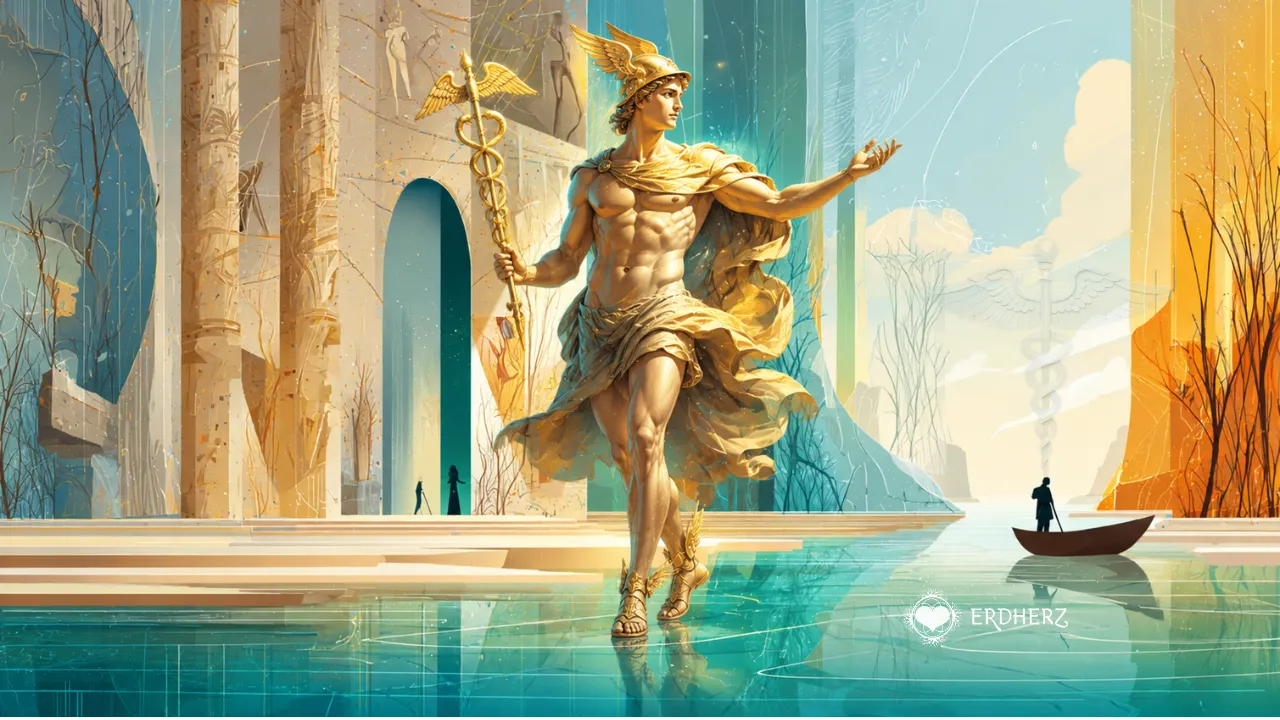
Hermes is one such figure.
Most people know him as the Greek messenger of the gods—swift, cunning, a boundary-crosser between worlds. But when we begin to look more deeply, something even greater opens behind this name:
Hermes—the god between worlds
In ancient Greece, Hermes was the god of magic, language, knowledge, and transitions.
He was not merely a messenger. He was a mediator:
The Romans called him Mercury.
Yet that too was only another translation of the same force.
For the Greeks already knew:
They had not “invented” this knowledge themselves. Many of their philosophers and priests travelled to Egypt—to the temples of a far older civilization.
And it is there that we meet him again.
Thoth—the scribe of the gods
In ancient Egypt, Hermes appears under another name:
Thoth—also known as Djehuti.
He was regarded as:
- God of wisdom
- Keeper of writing
- Master of cosmic order
Thoth was the one who preserved and transmitted knowledge about the structure of the universe.
Tradition also attributes to Thoth the knowledge and embodiment of remaining in a healthy, youthful body for thousands of years. Later, during the Hellenistic period, roughly 300 BCE to 300 CE, Greek and Egyptian traditions merged into one figure:
The so-called Hermetic writings are attributed to him, including the legendary Emerald Tablets.
One of their best-known statements:
“As above, so below.”
A formula that remains central to many spiritual and scientific models of thought.

Myth, memory, or lost history?
This is where it becomes fascinating. For there are traditions that reach further back than our established historiography.
They speak of a civilization before our time—often associated with the name Atlantis.
In these accounts he appears as Thoth the Atlantean, a teacher or initiate who preserved and transmitted knowledge after a great catastrophe. After the fall of Atlantis, he is said to have created a new place of initiation around the pyramids of Giza.
Hermes Trismegistus means Hermes, the thrice-greatest master. This is why he is understood as the master of all masters.
As the origin of an initiatory tradition through which the great teachers of the West were believed to have passed.
The Magician—and the path of initiation
If we follow this trail further, it leads us not only into myth or history.
It leads into a system that still exists today—
often overlooked, sometimes misunderstood,
and yet astonishingly precise:
Tarot.
The twenty-two Major Arcana are more than cards.
They describe a path of initiation.
A path whose origin lies in the mystery teachings of ancient Egypt—
in the teachings of Thoth.
It is no coincidence that the deck developed by Aleister Crowley bears the name
Thoth Tarot.
Here the connection becomes visible:
Hermes—Thoth—the Magician.
A line running through time.
The twenty-two archetypes on the Magician’s path
The twenty-two archetypes of the Major Arcana describe the initiate’s path.
Not merely as symbols.
But beyond that, as lived experience in everyday life.
They are the path through the mysteries—the arcana—of life.
Mysteries not in the sense of something “hidden,”
but in the sense of something
not yet accessible to a passing glance.
They open through maturity.
Through experience.
Through inner readiness.
My own initiation
More than twelve years ago, the cards found me.
And I have walked this path ever since.
Near the beginning, I faced an experience
that changed everything.
I reached a point
at which I believed I was about to die.
And inwardly I gave my consent.
It was not a thought.
It was a decision.
A letting go.
And in that very moment
something died.
Not my body.
But my old life—
in the sense of belief instead of knowledge.
And at the same time, something opened.
For the first time, I experienced myself—
beyond concepts,
beyond words.
As what I am.
Awareness.
A soul.
Infinite.
Immortal.
Beyond time and space.
That was my first initiation.
And many more have followed since.
And perhaps this is Hermes
When we bring all of this together, Hermes is not a figure of the past. Nor is he a myth we are asked to believe.
He is a principle.
A path.
An invitation.
The Magician.
The mediator.
The one who moves between worlds.
And the essential question is no longer:
Who was Hermes?
But:
Are you ready to walk this path yourself?


